
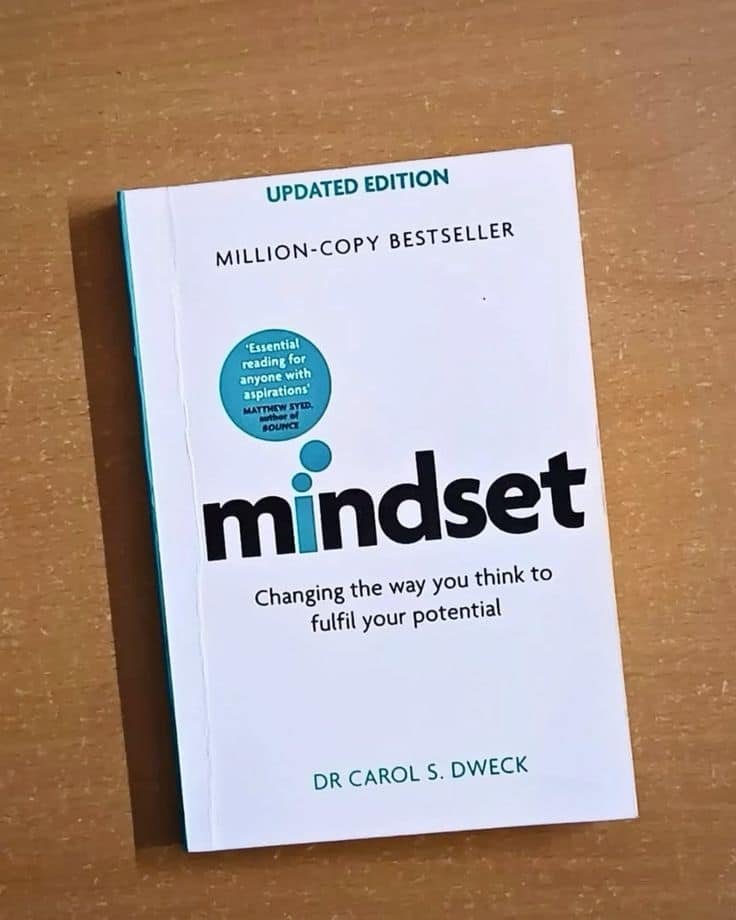

The book Mindset: The New Psychology of Success by Carol S. Dweck is one of the most influential psychology books in personal development. It explains why some people thrive in the face of challenges while others give up easily.
At the heart of the book is a simple but powerful idea: the beliefs you hold about your abilities shape your success in life.
In this detailed Mindset by Carol Dweck book summary and lessons guide, you will learn:
-
The difference between a fixed mindset and a growth mindset
-
How mindset influences success, learning, and relationships
-
Why failure can actually lead to improvement
-
Practical lessons you can apply to your own life
Understanding these ideas can transform how you approach challenges, effort, and personal growth.
What Is the Book Mindset About?
The core idea in this Mindset by Carol Dweck book summary is that people generally develop one of two types of mindsets:
-
Fixed mindset
-
Growth mindset
These beliefs affect how individuals approach success, failure, and learning.
People with a fixed mindset believe that intelligence and talent are static. They often avoid challenges because failure threatens their identity.
On the other hand, people with a growth mindset believe abilities can improve through effort and learning. As a result, they embrace challenges and see mistakes as opportunities.
This difference may seem small, but it influences almost every area of life.
Fixed Mindset vs Growth Mindset Explained
The Fixed Mindset
In a fixed mindset, individuals believe their abilities are predetermined. Talent is seen as something you either have or you do not.
Because of this belief, people with a fixed mindset often:
-
Avoid difficult challenges
-
Feel threatened by criticism
-
Give up easily after setbacks
-
Compare themselves constantly to others
They often seek validation instead of improvement.
The Growth Mindset
A growth mindset is built on the belief that skills can develop over time. Effort, persistence, and learning are seen as the path to mastery.
People with a growth mindset tend to:
-
Embrace challenges
-
Learn from mistakes
-
Persist through difficulties
-
Seek feedback to improve
This mindset encourages resilience and long-term success.
Mindset by Carol Dweck Book Summary: Key Ideas
The Power of Beliefs
One of the most important lessons in this Mindset by Carol Dweck book summary and lessons guide is that beliefs shape behavior.
If someone believes they cannot improve, they stop trying. However, when people believe they can grow, they invest effort and continue learning. Over time, this belief becomes a self-fulfilling cycle.
Effort Is the Path to Mastery
In a fixed mindset, effort may be seen as proof of weakness. People may think that talented individuals succeed effortlessly. However, Dweck shows that effort is essential for growth.
Hard work allows individuals to develop skills, refine strategies, and improve performance. In other words, effort is not a sign of weakness. It is the pathway to mastery.
Failure Is a Learning Tool
Another key idea in Mindset is the role of failure in learning. People with a fixed mindset interpret failure as proof of inadequacy. This often leads to discouragement.
However, people with a growth mindset see failure differently. They treat mistakes as feedback. By analyzing setbacks, they gain knowledge that helps them improve.
How Mindset Affects Different Areas of Life
Mindset in Education
Students with a growth mindset are more likely to persist when learning difficult subjects.
They understand that intelligence is not fixed. As a result, they invest more effort and ultimately achieve better results.
Mindset in Business and Leadership
Leaders with a growth mindset encourage learning and collaboration. They value effort, innovation, and improvement rather than perfection. This creates organizations where employees feel safe taking risks and developing new skills.
Mindset in Relationships
Mindset also affects personal relationships. People with a fixed mindset may expect relationships to remain perfect. When problems arise, they interpret them as signs of incompatibility. However, a growth mindset encourages communication, effort, and development within relationships.
Major Lessons from Mindset by Carol Dweck
Here are the most important takeaways from this Mindset by Carol Dweck book summary and lessons guide.
1. Your abilities can develop over time
Skills and intelligence are not fixed traits. With effort and practice, they can improve significantly.
2. Challenges create growth
Difficult tasks provide opportunities to learn and develop stronger abilities.
3. Failure is part of success
Mistakes provide valuable feedback that leads to improvement.
4. Effort leads to mastery
Consistent effort and practice help individuals develop expertise.
5. Feedback accelerates learning
Constructive criticism helps people identify areas for improvement.
Why Mindset Became a Global Bestseller
Mindset became widely popular because its ideas are simple yet powerful.
The concept of fixed and growth mindsets provides a framework for understanding motivation, achievement, and resilience.
These ideas have influenced education systems, leadership training, and personal development programs around the world.
Frequently Asked Questions
What is the main idea of the book Mindset?
The main idea is that believing your abilities can grow leads to greater learning, resilience, and success.
What is the difference between fixed and growth mindset?
A fixed mindset believes abilities are static, while a growth mindset believes skills can develop through effort and learning.
Why is the growth mindset important?
A growth mindset encourages persistence, learning from mistakes, and long-term improvement.
Final Thoughts
This Mindset by Carol Dweck book summary and lessons guide shows how powerful beliefs can shape success.
When individuals adopt a growth mindset, they become more resilient, motivated, and willing to learn.
By embracing challenges and viewing failure as feedback, anyone can develop new skills and unlock their potential.