
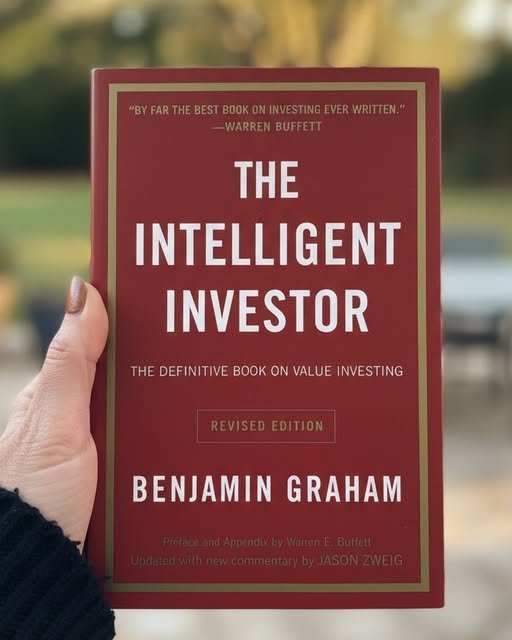

Reading The Intelligent Investor feels less like reading an investing guide and more like sitting across from a calm, slightly stern mentor who has already seen financial disaster — and wants to make sure you don’t repeat it.
Benjamin Graham wasn’t writing during a bull market celebration. He had survived the 1929 crash. He had watched speculation destroy fortunes. This book is born from scars, not theory.
And that’s why it feels different.
The Real Question Graham Is Asking
Most people open this book thinking: “How do I pick winning stocks?” Graham’s real question is more uncomfortable: “How do you avoid losing money due to your own poor judgment?”
He repeatedly emphasizes that successful investing is not about brilliance — it’s about discipline.
Investment vs. Speculation
Graham begins by drawing a strict line:
An investment operation is one that:
-
Is based on thorough analysis,
-
Promises safety of principal,
-
And delivers an adequate return.
Anything else is speculation. Notice he says adequate, not extraordinary. Right away, Graham reframes investing as something steady and rational — not thrilling.
He warns that markets constantly tempt investors to blur the line between investing and gambling.
The Defensive Investor Strategy
Graham divides investors into two categories:
The Defensive (Passive) Investor
This person:
-
Wants simplicity.
-
Doesn’t want to analyze individual securities deeply.
-
Prefers safety and stability.
For this investor, Graham recommends:
-
A balanced portfolio of stocks and bonds.
-
High-quality, dividend-paying companies.
-
Broad diversification.
-
Limited turnover.
He emphasizes that asset allocation — especially the balance between stocks and bonds — should adjust based on market conditions but remain grounded in prudence.
He discourages chasing fashionable stocks.
The Enterprising (Active) Investor
This investor is willing to:
-
Put in time.
-
Study financial statements.
-
Look for undervalued companies.
But even here, Graham imposes strict filters:
The enterprising investor should look for:
-
Low price-to-earnings ratios.
-
Low price-to-book ratios.
-
Strong balance sheets.
-
Consistent earnings history.
-
Manageable debt.
He is not advocating reckless stock picking. He is advocating systematic bargain hunting.
Mr. Market — The Psychological Masterpiece
This is the section most readers remember — but it’s more profound than it first appears. Graham introduces Mr. Market, your imaginary business partner. Each day, Mr. Market offers to buy your shares or sell you his at a certain price. But here’s the catch:
He is emotionally unstable. Some days he’s euphoric. Some days he’s depressed.
The intelligent investor understands something critical: Price is what Mr. Market offers. Value is what you determine.
You are free to ignore him. This is Graham teaching emotional detachment.
Volatility is not risk. Emotional reaction to volatility is.
Margin of Safety — The Central Doctrine
If you had to reduce the entire book to one principle, it would be this: Always build a margin of safety into your investments.
This means buying assets significantly below their intrinsic value.
Why? Because:
-
You will miscalculate.
-
Analysts will be wrong.
-
Economic conditions will change.
The margin of safety absorbs error. It’s engineering applied to finance — build a bridge strong enough to carry more weight than expected.
This is conservative, almost cautious investing. But that caution is precisely what creates long-term stability.
Market Fluctuations Are Opportunities (Not Threats)
Graham reframes how we interpret downturns.
Most investors panic during falling markets.
Graham says:
-
If you’re a seller, prices matter.
-
If you’re a long-term owner, falling prices are opportunities.
He encourages investors to see market corrections as clearance sales — if fundamentals remain intact.
This requires emotional strength.
Dividends, Earnings, and Financial Strength
Graham consistently returns to fundamentals:
-
A long history of stable earnings.
-
A record of uninterrupted dividends.
-
Moderate debt.
-
Conservative financial practices.
He distrusts companies built purely on promise or narrative. In modern terms, he would likely be skeptical of hype-driven, profitless growth stocks. He prefers evidence over excitement.
Inflation and Investor Expectations
Later editions (with commentary) address inflation. Graham warns that inflation erodes purchasing power — and investors must account for real returns, not just nominal gains.
He also criticizes unrealistic expectations. Many investors expect:
-
Rapid growth,
-
Outperformance,
-
Market-beating returns.
Graham’s philosophy is almost boring by comparison. But boring works.
The Deeper Philosophy: Investing Is Character Training
Underneath all the financial instruction lies something more subtle. The Intelligent Investor is about temperament.
Graham argues that intelligence alone is insufficient. You need:
-
Patience,
-
Emotional control,
-
Independent thinking,
-
Humility.
He repeatedly warns against:
-
Following the crowd,
-
Reacting emotionally,
-
Confusing activity with productivity.
In this sense, the book is psychological before it is financial.