
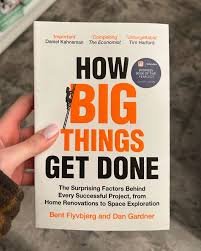

Why do so many large projects fail? Why do governments blow billions on infrastructure that never meets expectations? Why do tech companies miss deadlines on major launches? Why do megaprojects routinely go over budget?
In How Big Things Get Done, Bent Flyvbjerg delivers a data-driven, brutally honest answer. This book isn’t about motivational slogans or wishful thinking, it’s about why big projects fail and, more importantly, what strategies actually help them succeed.
If you care about project management lessons, execution strategy, or delivering complex projects, this book is essential reading.
What How Big Things Get Done Teaches About Project Failure
Flyvbjerg has studied thousands of megaprojects worldwide—from bridges and rail systems to corporate IT systems. His research reveals a shocking pattern:
-
Most big projects go over budget.
-
Most are delivered late.
-
Many fail to deliver the promised benefits.
-
Some even destroy organizations.
And here’s the kicker: it’s rarely bad luck. The mistakes are systematic. The book’s central idea can be summed up in one phrase: Think slow, act fast.
Successful projects spend time planning carefully, analyze historical data, break down complexity early, and stress-test assumptions. Failed projects rush in, underestimate costs, and ignore lessons from the past.
This principle is central to modern project management strategy.
Key Lessons from How Big Things Get Done
The Iron Law of Megaprojects
Flyvbjerg identifies the “iron law of megaprojects”: Over budget. Over time. Under benefits. Over and over again. Why? Two main forces drive failure:
-
Optimism bias – believing everything will go smoothly.
-
Strategic misrepresentation – underestimating costs or timelines to get approval.
Understanding these patterns is the first step toward preventing failure.
Reference Class Forecasting Beats Guesswork
Instead of predicting outcomes based on your project alone, Flyvbjerg recommends reference class forecasting:
-
Find similar past projects.
-
Analyze their actual outcomes.
-
Use this data to make realistic forecasts.
This method removes ego and speculation, improving project accuracy—a core tool for avoiding why big projects fail.
Modular Design Reduces Risk
Successful large projects are built in smaller, manageable components. Modular design helps:
-
Reduce complexity
-
Improve predictability
-
Allow scalability
Whether it’s infrastructure or tech systems, breaking projects into smaller parts mitigates the risk of catastrophic failure.
Systems Matter More Than Heroes
Charismatic leaders don’t guarantee success. Flyvbjerg shows that governance, incentive alignment, accountability, and transparency matter more than any single personality.
Projects fail when politics override planning, incentives reward optimism over accuracy, or oversight is weak. Systems beat heroics every time.
Discipline Over Ambition
Ambition is necessary for big projects, but unchecked ambition leads to disaster. Successful projects balance vision with:
-
Scope control
-
Funding discipline
-
Operational focus
Execution is structured, not glamorous. This discipline explains why some projects succeed while others fail.
Real-World Examples of Why Big Projects Fail
Flyvbjerg illustrates his points with concrete examples:
-
Infrastructure megaprojects
-
Olympic Games budgets
-
Large transportation systems
-
Corporate digital transformations
These cases show that megaproject failure is predictable—and preventable with the right strategies.
Why This Book Matters Today
In a world of:
-
Massive infrastructure spending
-
Startup scaling and tech rollouts
-
Government mega-investments
-
Climate transition projects
Understanding why big projects fail and how to prevent it is more relevant than ever. This book isn’t just about construction; it’s about execution at scale.
Who Should Read How Big Things Get Done?
This book is perfect for:
-
Project managers
-
CEOs and founders
-
Government officials
-
Strategy consultants
-
Corporate leaders
-
MBA students
If you manage complexity, Flyvbjerg’s insights are directly applicable.
Final Review: Lessons on Why Big Projects Fail
Bent Flyvbjerg doesn’t rely on motivational slogans. He relies on data. His biggest takeaway: Big projects don’t fail because they’re ambitious. They fail because they ignore reality.
With proper project management lessons, modular design, reference class forecasting, and disciplined execution, failure becomes avoidable.
If you want to understand why big projects fail and how to make them succeed, this is a must-read.