
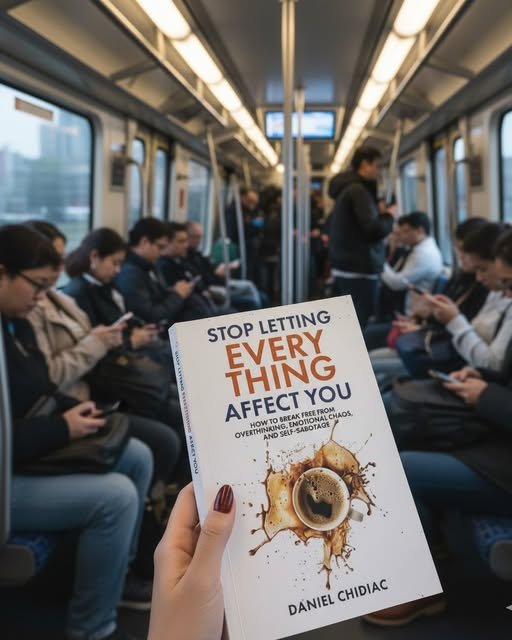

I didn’t pick up Stop Letting Everything Affect You expecting much. The title alone sounds like something you’d scroll past on Instagram, nod at, and forget. But somewhere between the blunt chapter openings, the uncomfortable truths, and the oddly calming clarity of the ideas, this book quietly does something dangerous: it makes you realize how much of your suffering is optional.
Not imaginary.
Not fake.
Optional.
Daniel Chidiac doesn’t write like someone trying to impress you with psychology jargon or motivational hype. He writes like someone who’s watched people — and himself — spiral over things that, when stripped down, didn’t deserve that much power. This book feels less like a lecture and more like a conversation with someone who keeps stopping you mid-rant and asking, “Okay, but why is this affecting you so deeply?”
That question becomes the spine of the entire book. Below are some of the most powerful lessons and ideas from Stop Letting Everything Affect You — the kind that linger long after you close the last page.
You Are Reacting, Not Responding
One of the first uncomfortable truths the book introduces is this: most of us are not living intentionally, we are reacting on autopilot. Someone says something offhand. Your mood shifts.
Someone doesn’t reply. Your mind fills in ten worst-case stories. Something doesn’t go as planned. You spiral.
Chidiac makes it painfully clear that the problem isn’t that life is happening, it’s that everything is happening inside you at full volume.
A recurring theme in the book is that external events are controlling your internal state. Not because you’re weak, but because no one ever taught you how to pause between stimulus and response. Learning that pause is where emotional control begins.
Overthinking Is the Illusion of Control
One of the most relatable sections of the book is how it dismantles overthinking, not by shaming it, but by exposing it. Overthinking, Chidiac argues, isn’t deep thinking. It’s mental looping. The mind believes that if it keeps replaying scenarios, it can protect you from pain, embarrassment, or uncertainty.
But here’s the key insight: overthinking doesn’t prepare you, it drains you. The book reframes overthinking as a misplaced attempt at control. Your brain stays busy not because the thoughts are useful, but because stillness feels unsafe. Rather than saying “stop thinking,” the book teaches you to interrupt the loop by asking:
-
Is this thought useful right now?
-
Is it actionable?
-
Or am I just mentally rehearsing pain?
That distinction alone can change how you relate to your thoughts.
Emotional Reactivity: Why Everything Feels Personal
One of the quiet strengths of Stop Letting Everything Affect You is how it explains emotional reactions without turning them into a character flaw. You’re not “too sensitive.” You’re untrained in emotional regulation.
Chidiac explains that emotions are physical responses first and thoughts second. Your body reacts before your mind can make sense of what’s happening, which is why you can logically understand something isn’t serious and still feel shaken.
Instead of suppressing emotions, the book teaches you to slow them down. Pause. Breathe. Name what’s happening. “I feel anxious” becomes “I notice anxiety is present.” That small shift creates distance. And distance creates choice.
The Brutal Truth About Taking Things Personally
If there’s one message the book returns to relentlessly, it’s this: most things are not about you.
Someone’s mood.
Someone’s tone.
Someone’s lack of effort.
Someone’s reaction.
We internalize everything because we assume the world is responding to us. Chidiac dismantles this idea by reminding readers that people act from their own fears, wounds, habits, and insecurities, not as referees of your worth. Once this sinks in, emotional weight begins to lift.
Boundaries: The Skill Nobody Taught You
A major reason everything affects you is because your emotional boundaries are porous. Chidiac doesn’t describe boundaries as walls or emotional coldness. He frames them as filters. Not everything deserves access to your emotional energy.
The book explores:
-
how people-pleasing keeps you emotionally trapped
-
why guilt is often mistaken for kindness
-
why saying no feels wrong simply because it disrupts familiarity
One of the most freeing realizations in the book is this: discomfort doesn’t mean you’re doing something wrong. Often, it means you’re doing something new.
Self-Sabotage Is Fear Wearing a Different Outfit
Another standout lesson in the book is how it reframes self-sabotage.
Procrastination. Avoidance. Inconsistency. These aren’t failures of discipline, they’re attempts to avoid emotional discomfort. Fear of failure. Fear of success. Fear of being seen.
Chidiac points out that humans often choose familiar pain over unfamiliar growth. Until you understand what you’re avoiding emotionally, no productivity system will fix it.
Instead of dramatic change, the book encourages micro-commitments, small, consistent actions that build trust with yourself. Not motivation. Evidence.
Detachment Does Not Mean Indifference
One of the most misunderstood concepts in the book is emotional detachment. Detachment doesn’t mean you stop caring. It means you stop letting outcomes define your self-worth. You can care without catastrophizing. You can feel without spiraling. You can be involved without being consumed.
This is the difference between being emotionally available and emotionally entangled.
Growth Feels Like Loss Before It Feels Like Freedom
One of the book’s most honest insights is that growth hurts before it helps. You’re not just letting go of pain, you’re letting go of familiarity. Old coping mechanisms. Old identities. Old patterns that once kept you safe.
That’s why growth feels destabilizing. You lose a version of yourself before the new one feels solid. The book doesn’t glamorize this discomfort — it normalizes it.
The Quiet Message Behind the Entire Book
At its core, Stop Letting Everything Affect You isn’t about becoming cold, detached, or unbothered.
It’s about reclaiming authorship over your inner world. It’s about realizing that peace isn’t something life gives you, it’s something you learn to protect.
Once you see how much energy you’ve been donating to things that don’t deserve it, you don’t feel guilty. You feel free.
Final Thoughts
This book doesn’t yell at you to change. It calmly shows you where you’ve been leaking emotional energy, and lets you decide what to do with that awareness.
If you’ve ever:
-
felt emotionally drained by small things
-
overthought yourself into exhaustion
-
taken responsibility for other people’s moods
-
wanted peace but didn’t know how to hold onto it
This book feels like someone gently turning down the noise in your head. Not all at once — just enough for you to breathe.