
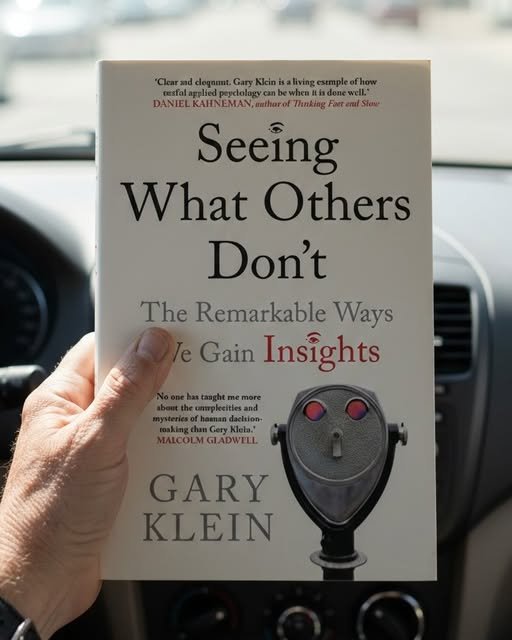

Imagine walking into a room and noticing patterns that everyone else walks past. That’s the magic Gary Klein explores in Seeing What Others Don’t.
This isn’t a book for people who like to play it safe or follow the crowd. It’s for those who want to understand how experts see what most people miss, make smarter decisions, and spot opportunities before anyone else does.
The Story Behind the Book:
Klein is a cognitive psychologist who’s spent decades studying experts firefighters, pilots, military commanders, doctors people whose lives depend on rapid, high-stakes decisions.
Instead of focusing on theoretical models, he tells stories from the frontlines. Stories where a firefighter notices a tiny smoke pattern that signals an imminent roof collapse, or a doctor spots a rare symptom before it becomes critical.
The central premise is simple but powerful: experience + pattern recognition = insight. Some people see what others can’t and Klein teaches us how to cultivate that ability.
Key Insights From Seeing What Others Don’t
Patterns Are Everywhere, if You Know How to Look
Klein emphasizes that expertise isn’t just knowledge. It’s the ability to recognize subtle patterns in chaotic environments.
He shows how experts develop pattern recognition over time sometimes through years of experience, sometimes through intense observation and reflection.
Lesson for readers: train your mind to notice small anomalies they often point to bigger truths.
Insights Don’t Always Come From Logic
Some of the book’s most memorable moments are the stories of “aha!” realizations insights that seem to appear out of nowhere. Klein explains that insight isn’t random. It comes from:
-
Accumulated experience
-
Deep immersion in a domain
-
Openness to new perspectives
If you rely only on spreadsheets and formulas, you’ll miss the signals others catch instinctively.
Mindsets Matter
Klein identifies psychological barriers that block insight:
-
Confirmation bias: seeing only what supports your beliefs
-
Overconfidence: dismissing anomalies as irrelevant
-
Fear of being wrong: avoiding the uncomfortable truth
The key? Stay curious, humble, and willing to question assumptions.
Break Routines, See Differently
Sometimes seeing what others don’t requires deliberately breaking your routines. Klein shares stories where people changed their perspective literally or metaphorically and suddenly saw solutions that were hidden in plain sight.
Example: a firefighter approaches a burning building from a different angle and notices a structural weakness no one else sees. Lesson: perspective matters.
Capture and Reflect
Klein stresses the importance of reflection. Insights often come after action, not just before it.
He recommends keeping mental or written records of unusual observations, revisiting them later, and connecting the dots. That’s how patterns turn into breakthroughs.
Teamwork Can Reveal What You Miss
Some insights emerge not alone but through collaboration. Diverse perspectives often spot patterns that a single expert might miss. Lesson: build teams with complementary experience and viewpoints to enhance collective insight.
Expertise Isn’t About Intelligence Alone
Reading this book makes it clear: being smart isn’t enough. Experience, context, and observation are what differentiate the insightful from the average observer. You can be brilliant on paper but blind in practice.