
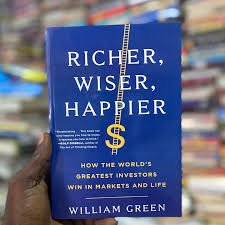

Most people think investing greatness is about picking the right stock at the right time.
It’s not. After reading Richer, Wiser, Happier by William Green, one thing becomes painfully clear: The real edge isn’t information. It’s temperament.
And this book proves it through intimate, behind-the-scenes conversations with some of the greatest investors alive, including Charlie Munger, Warren Buffett, Howard Marks, Joel Greenblatt, Sir John Templeton, and the unusually thoughtful Nick Sleep.
But here’s the twist: This isn’t a book about how to get rich fast. It’s about how to think so well that getting rich becomes a by-product.
So What Is Richer, Wiser, Happier Really About?
William Green spent more than two decades interviewing elite investors. Not quick soundbite interviews — deep, reflective, philosophical conversations.
He wasn’t asking:
-
“What stock should we buy?”
-
“Where is the market going next year?”
He was asking:
-
How do you think?
-
How do you survive crashes?
-
How do you avoid blowing up?
-
How do you build wealth without destroying your peace?
And what you get is something far more powerful than a strategy manual. You get mental models for life.
Lesson 1: The Calm Mind Makes the Most Money
If you study the legends, one trait shows up again and again: They are almost disturbingly calm.
Charlie Munger doesn’t chase brilliance. He avoids stupidity. Howard Marks obsesses over risk, not returns. Buffett waits. And waits. And waits. Meanwhile, the average investor:
-
Panics during crashes
-
Buys during hype
-
Checks their portfolio 12 times a day
Green makes it obvious: the market transfers money from the impatient to the disciplined. You don’t need to be the smartest person in the room. You need to be the least emotional.
Lesson 2: Long-Term Thinking Is a Superpower
One of my favorite parts of the book is how it dismantles short-term thinking. Nick Sleep built extraordinary wealth by focusing obsessively on companies that treat customers exceptionally well — then holding them for years.
Sir John Templeton made fortunes by buying when fear was at its peak — when nobody else wanted to touch the market. These investors think in decades. Not quarters. Not weeks. Decades.
In a world addicted to instant results, patience becomes a competitive advantage.
Lesson 3: Avoiding Ruin Is More Important Than Getting Rich
This is one of the most underrated investing lessons. The great investors aren’t obsessed with hitting home runs. They’re obsessed with survival. Howard Marks talks extensively about risk — not volatility, but permanent loss of capital. Compounding only works if you don’t interrupt it. And you interrupt it by:
-
Taking excessive leverage
-
Following hype
-
Believing you’re smarter than the cycle
The book quietly teaches something powerful: If you avoid catastrophe long enough, wealth almost becomes inevitable.
Lesson 4: Simplicity Beats Flashiness
Joel Greenblatt created systematic strategies to remove emotion from investing. Buffett built an empire buying understandable businesses. No crypto frenzy. No day-trading theatrics. No prediction obsession. Just clarity, discipline, and consistency.
It’s almost boring. And that’s the point. Investing done well looks boring, until you see the compounding decades later.
Lesson 5: The “Happier” Part Is Not Marketing Fluff
This book could have been called “Richer and Smarter.” But William Green intentionally added “Happier.” Why? Because several investors he profiles are deeply reflective about life. They talk about:
-
Designing an intentional lifestyle
-
Avoiding ego traps
-
Building intellectual curiosity
-
Defining what “enough” means
This is where the book becomes more than finance. It becomes philosophy. It echoes themes from books like:
-
The Intelligent Investor
-
The Psychology of Money
But with more storytelling, more humanity, more lived experience. It makes you ask: What’s the point of getting rich if you’re anxious, arrogant, and exhausted?
What Makes This Book Different?
Most investing books:
-
Teach formulas.
-
Sell certainty.
-
Promise outperformance.
This one does something subtler.
It shows you how elite thinkers approach uncertainty. You see their mistakes. Their doubts. Their intellectual humility. And that’s rare.
William Green doesn’t pedestal them as superheroes. He shows their process — the reading habits, the thinking frameworks, the psychological guardrails. And that’s what makes this book powerful.
Who Should Read Richer, Wiser, Happier?
If you:
-
Invest in stocks or ETFs
-
Want to build generational wealth
-
Are tired of hype-driven finance advice
-
Care about mindset as much as money
This book will shift how you think. Not in a loud way. In a quiet, recalibrating way.
My Honest Take as an Investing Educator
If I were teaching a long-term investing class, this would be required reading. Not because it gives you stock picks. But because it rewires how you approach:
-
Risk
-
Patience
-
Ego
-
Discipline
-
Time
And those things matter more than any ticker symbol. The biggest takeaway? The goal isn’t just to compound money. It’s to compound wisdom. And if you do that long enough, wealth follows.