
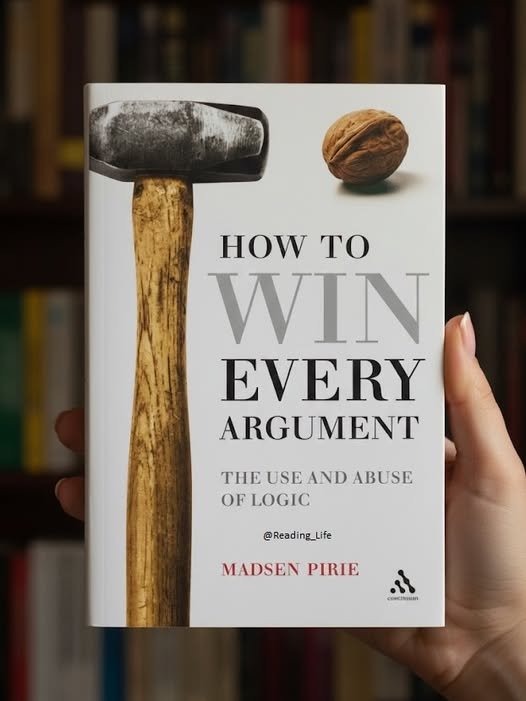

How to Win Every Argument: The Use and Abuse of Logic by Madsen Pirie is a witty, insightful guide to logic, reasoning, and argumentation that teaches readers not only how to argue well but also how to identify faulty reasoning in others. The book is structured as an engaging reference to logical fallacies — common errors in reasoning — and shows how understanding them improves critical thinking, persuasion, and debate skills.
Whether you want to detect weak arguments online, strengthen your own reasoning, or simply think more clearly, this book acts as both a toolkit and a practical manual for navigating disagreements with confidence.
Understanding Arguments
Pirie starts by defining what an argument truly is, not just a quarrel, but a structured attempt to persuade someone using reasons and evidence. A successful argument is one that is logically sound, based on credible evidence, and clearly communicated.
Unlike many books that only teach formal logic, Pirie examines the real‑world messy arguments we encounter every day — on social media, in meetings, with friends, or in written discussions. He dissects what goes wrong when logic breaks down and shows how those breakdowns can be used strategically.
Part 1: The Foundation — Logic and Reasoning
What Is an Argument?
At its core, an argument is a claim supported by reasons and evidence. Understanding arguments means analyzing how claims are supported, whether the evidence is reliable, and whether reasoning follows logically from premises to conclusion.
What Makes an Argument Successful?
A successful argument typically has:
-
A clear claim or conclusion
-
Valid logical structure
-
Reliable and relevant evidence
-
Resistance to fallacies or irrelevant distractions
Pirie emphasizes that arguments are not won purely by emotion or volume; they are won by clarity and logic.
Fallacies — The Heart of Winning Arguments
The bulk of the book is a detailed A–Z of logical fallacies, where Pirie explains the most common reasoning errors people make — how they occur, why they deceive, and how to spot them in conversation or writing.
Examples of Common Fallacies
Here are a few representative examples:
✔ Abusive Analogy
This fallacy compares two things in a way that seems persuasive but is actually irrelevant or misleading. Instead of disproving an argument, it ridicules the opponent’s position indirectly.
✔ Red Herring
A distraction technique that introduces irrelevant material to divert attention from the real issue. These derailments often look convincing at a glance but fail rigorous logical inspection.
✔ Bogus Dilemma (False Dilemma)
This occurs when a complex issue is oversimplified into only two possible options, ignoring other viable alternatives.
✔ Ad Hominem
Attacking a person’s character instead of their argument, for instance criticizing the speaker’s motives instead of addressing the substance of what they’re saying.
✔ Gambler’s Fallacy
The mistaken belief that past random events affect future ones (e.g., “If it’s rained all week, it must stop tomorrow”), often used incorrectly in reasoning about probability. Each fallacy entry includes:
-
Definition
-
Real‑world examples
-
Explanation of why it’s deceptive
-
Tips on spotting or countering it
This thorough catalogue equips readers with a mental vocabulary of errors to avoid and recognize when others use them.
Part 3: Argument in Practice — Oral and Written
Pirie doesn’t limit his advice to abstract logic — he applies it to everyday contexts:
Oral Arguments
In conversations, debates, or meetings, arguments are influenced by tone, style, and structure as much as content. Pirie shows how to:
-
Ask clear questions
-
Listen actively
-
Avoid common traps like emotional hijacking
-
Respond with logic under pressure
Written Arguments
Whether you’re writing an email, article, or online post, the principles of logic still apply. Pirie covers:
-
Structuring written arguments
-
Avoiding ambiguity
-
Strengthening evidence
-
Using precise language to persuade effectively
He even includes guidance on winning arguments on social media platforms, like Facebook or Twitter’s 140 characters, where brevity and clarity matter.
Critical Thinking and Self‑Defense
One of the most valuable takeaways is how the book builds critical thinking skills. By learning to identify fallacies, readers not only improve their own arguments but also learn to defend against flawed reasoning used by others.
Pirie suggests that mastering logic gives you a kind of mental immunity — you start spotting manipulation, weak claims, or emotional tricks before they take effect. This enhances your ability to think independently and respond sensitively in debates.
Ethics of Argumentation
While How to Win Every Argument teaches tactics, Pirie also cautions about the ethical use of logic. The book makes clear that some people may choose to use fallacies intentionally — but understanding them should ideally lead to clearer truth‑seeking, not manipulation.
In other words, logic can be a tool for constructive dialogue as well as persuasive strategy. Learning when and how to use it responsibly is part of becoming a better communicator.
Summary of Key Lessons & Takeaways
-
Arguments are about structure, evidence, and clarity, not emotion or volume.
-
Logical fallacies are everywhere, spotting them builds sharper judgment.
-
Understanding reasoning improves listening, defending, and persuading.
-
Effective argumentation works in oral and written communication alike.
-
Critical thinking is both defensive and offensive, it helps you avoid being swayed and helps you persuade others.