
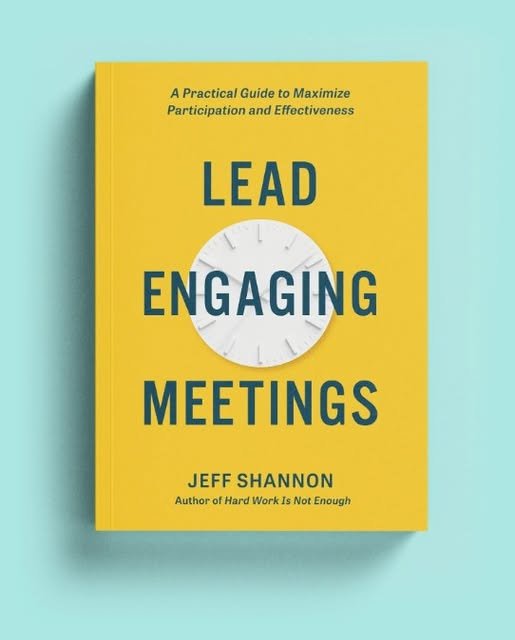

In Lead Engaging Meetings, author and facilitator Jeff Shannon argues that meetings are essential in professional life, but the majority of them are unproductive, boring, and wasteful. Every unengaging meeting costs time, energy, ideas, and momentum. Instead of being dreaded calendar blocks, meetings can be transformed into engaging, productive, and creative interactions when leaders apply intentional design and facilitation principles.
Shannon wrote this book as a practical, action‑oriented guide that helps readers plan, design, lead, and close meetings in ways that spark engagement, encourage participation, and deliver meaningful outcomes.
The Central Problem: Why Meetings Often Fall Short
Shannon highlights several reasons why meetings fail to deliver:
-
Lack of a clear purpose — Meetings without a specific goal lose direction and engagement.
-
Poor design and structure — Traditional agendas don’t always encourage participation or creative thinking.
-
Inadequate preparation — Meeting leaders often expect participants to “show up and contribute” without setting context in advance.
-
Dominant or disengaged participants — Some people overwhelm conversations, while others retreat into silence.
-
Unproductive pace and timing — Meetings that run too long or without breaks drain energy.
The book frames these as fixable issues, not inherent problems. By understanding the root causes of unproductive meetings, leaders can implement solutions that make gatherings more impactful.
Chapter 1: Start With Clear Intention
Shannon emphasizes that every meeting should begin with a clear intention, a well‑defined purpose that explains why the meeting is happening and what outcome is expected. This should not be vague (e.g., “stay in touch”) but specific and actionable.
To achieve this, he recommends crafting a meeting brief that includes:
-
The context of the issue at hand
-
The problem to be solved or decision to be made
-
The desired outcome/result
-
A thoughtful agenda based on questions instead of generic topics
-
Roles and expectations for participants
This early clarity helps participants come prepared and mentally engaged before the meeting begins.
Chapter 2: Designing an Engaging Meeting
Good meetings begin long before the scheduled start time. Shannon outlines how effective planners think about:
1. Timing and Flow
-
Choose meeting times when participants are most alert (often morning hours).
-
Break the meeting into increments that allow for focused engagement, reflection, and progress.
2. Spatial Setup and Materials
-
Arrange the room or digital space to facilitate interaction.
-
Provide a facilitator guide, a roadmap that includes prompts, timelines, discussion questions, and checkpoints.
3. Agenda Structure
Instead of a list of topics, Shannon suggests using question‑based agendas that invite discussion and collaboration. This encourages participants to think actively and prepares them to contribute insights.
Chapter 3: Preparation Is Key
Shannon stresses that meeting success depends on pre‑meeting preparation. This includes:
-
Sharing context and background materials in advance
-
Clarifying expectations for attendance and contribution
-
Deciding which tools (e.g., slides, whiteboards, breakout groups) will help the meeting objectives
-
Reducing distractions before participants arrive
Preparation boosts confidence — both for the facilitator and the participants — and sets a positive tone for collaboration.
Chapter 4: Setting the Tone and Launching the Meeting
How you start a meeting affects how participants behave throughout it. Shannon suggests:
-
Welcoming participants warmly and making them feel their time is valued
-
Setting agreements, simple norms about how people engage, such as listening respectfully and participating actively
-
Explaining the agenda and objectives clearly before diving into discussions
These introductory steps help create a productive environment where participants are more inclined to contribute meaningfully rather than check out mentally.
Chapter 5: Running the Meeting With Engagement
Once the meeting begins, Shannon’s guidance focuses on techniques that keep energy high:
Use Strategic Questions
Instead of professor‑like monologues, ask questions that spark thought, debate, and idea generation.
Small Group Activities
Breaking large groups into smaller discussion teams encourages quieter participants to share ideas and avoids one or two voices dominating the conversation.
Provide Signposts
Frequent check‑ins and transitions help participants understand where the meeting is heading and how each segment contributes to the outcome.
Take Breaks
For longer meetings, breaks refresh attention and help groups maintain productivity over time.
Chapter 6: Troubleshooting Common Meeting Problems
Shannon offers practical solutions for real‑world meeting challenges, such as:
-
Managing dominant participants who monopolize discussion
-
Drawing in quiet attendees without forcing participation
-
Handling topics that go off track
-
Responding to distractions or disruptions
-
Keeping the meeting on schedule without rushing the output
These troubleshooting tools help facilitators maintain control while preserving engagement and openness.
Chapter 7: Leading Virtual & Hybrid Meetings
As remote work becomes more common, Shannon dedicates guidance to virtual and hybrid meetings:
-
Use digital tools intentionally — screenshares, breakout rooms, polls, and chats can enhance — not distract, engagement
-
Call participants by name to foster inclusiveness
-
Avoid hybrid setups when possible, as they often amplify inequality between in‑room and remote participants
This modern guidance reflects the changing landscape of professional communication.
Chapter 8: Close With Impact
A strong ending helps ensure results stick. Shannon recommends:
-
Summarizing key decisions and next steps
-
Closing early if possible — ending even five minutes before the scheduled time leaves participants feeling the meeting was efficient and respectful of their time
Final Summary
Lead Engaging Meetings by Jeff Shannon is a practical and actionable guide for transforming ordinary meetings into engaging, productive, and impactful gatherings. Instead of accepting boring meetings as inevitable, Shannon’s roadmap offers clear steps to design, lead, and optimize meetings that inspire participation and deliver measurable results.
This book is ideal for professionals, team leaders, HR practitioners, corporate trainers, and anyone who facilitates or participates in meetings. With a focus on purpose, preparation, facilitation skills, and inclusive techniques, Shannon provides the tools to make every meeting count.