

What if everything you were taught about the efficient market hypothesis, rational investors, and perfect pricing… was only half true?
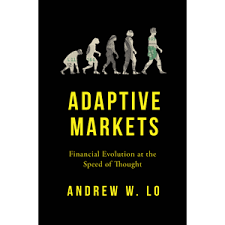
In Adaptive Markets: Financial Evolution at the Speed of Thought, Andrew W. Lo — MIT professor and hedge fund manager — delivers one of the most important modern investing frameworks: The Adaptive Markets Hypothesis (AMH).
This isn’t just another investing book. It’s a fundamental rethink of how financial markets actually work — blending economics, psychology, neuroscience, and evolutionary biology into one powerful theory.
If you’re serious about investing, behavioral finance, or understanding market cycles, this book changes how you see risk, bubbles, crashes, and opportunity.
What Is Adaptive Markets About?
At its core, Adaptive Markets challenges the traditional Efficient Market Hypothesis (EMH) — the idea that markets are always rational and prices reflect all available information.
Lo argues something more realistic: Markets aren’t perfectly efficient. They’re adaptive.
Investors are not hyper-rational robots. They’re biological organisms shaped by evolution, emotion, competition, and survival instincts.
Markets behave less like physics…and more like ecosystems. That shift in perspective is huge.
The Adaptive Markets Hypothesis (AMH) Explained
Lo introduces the Adaptive Markets Hypothesis as a bridge between:
-
Efficient Market Theory
-
Behavioral Finance
Instead of choosing one side, he argues both are partially right.
Here’s the core idea:
Markets evolve.
-
When competition is high → markets become more efficient.
-
When participants grow complacent → inefficiencies appear.
-
When new technology or regulation changes the landscape → behavior adapts.
Just like in nature, survival goes to the most adaptable. This explains:
-
Why anomalies appear and disappear.
-
Why strategies stop working.
-
Why bubbles form repeatedly.
-
Why risk is not constant over time.
Markets are not static systems. They’re constantly evolving environments.
Why Crashes and Bubbles Keep Happening
One of the strongest sections of the book explores financial crises, including the 2008 crisis.
Lo explains bubbles not as irrational insanity, but as:
-
Overconfidence under stable conditions
-
Herd behavior amplified by incentives
-
Risk-taking during prolonged calm
In evolutionary terms, investors respond to local environments. If risk-taking is rewarded for years, more risk-taking emerges. Until the environment shifts. Then the same behavior becomes catastrophic.
This evolutionary lens makes crashes feel less mysterious — and more predictable in pattern (though not timing).
Key Lessons from Adaptive Markets
Risk Is Not Constant
Traditional finance treats risk like a fixed statistic. Lo argues risk changes depending on:
-
Market structure
-
Competition
-
Regulation
-
Investor psychology
In other words: Risk is contextual. That has major implications for portfolio management.
Survival Matters More Than Optimization
In classical finance, investors maximize returns. In adaptive markets, investors survive.
Strategies that:
-
Work in one regime
-
Fail in another
Only those who adapt persist long-term. This explains why many hedge funds outperform temporarily, then disappear.
Innovation Changes Market Dynamics
Technology, algorithmic trading, ETFs, AI systems, all change the ecosystem. When new species enter the environment, competition increases. Efficiency rises. Old strategies die. Markets evolve faster today than ever before.
Behavioral Finance Is Not a Flaw — It’s Biology
Fear. Greed. Herding. Overconfidence. These aren’t bugs in the system. They’re evolutionary traits that helped humans survive. But in financial markets, those instincts can misfire.
Understanding this doesn’t mean eliminating emotion. It means designing systems that account for it.
Adaptive Markets vs Efficient Market Hypothesis
Traditional View (EMH):
-
Markets are efficient.
-
Alpha is nearly impossible.
-
Prices reflect all information.
Adaptive View (AMH):
-
Markets are sometimes efficient.
-
Inefficiencies appear and vanish.
-
Profit opportunities depend on environment.
-
Competition drives adaptation.
This nuanced middle ground is what makes Lo’s framework powerful. It doesn’t discard classical finance. It upgrades it.
Why This Book Matters for Modern Investors
In a world of:
-
AI trading
-
Meme stocks
-
Crypto volatility
-
Rapid information flow
A static theory of markets feels incomplete. Adaptive Markets gives investors a dynamic lens.
It encourages:
-
Flexibility
-
Continuous learning
-
Risk awareness
-
Strategic humility
If you invest in:
-
Stocks
-
ETFs
-
Quant strategies
-
Hedge funds
-
Or build financial models
This framework is invaluable.
How It Compares to Other Investing Classics
If you’ve read:
-
A Random Walk Down Wall Street
-
Thinking, Fast and Slow
-
The Intelligent Investor
Adaptive Markets sits at the intersection of them all. It combines:
-
Academic rigor
-
Behavioral science
-
Market history
-
Practical investment implications
But it’s more conceptual than tactical. This is a framework book, not a stock-picking guide.
Who Should Read Adaptive Markets?
This book is ideal for:
-
Finance students
-
CFA candidates
-
Professional investors
-
Quantitative analysts
-
Long-term portfolio managers
-
Anyone studying behavioral finance
It’s intellectually demanding at times — but deeply rewarding.
Final Review: Is Adaptive Markets Worth Reading?
Yes — especially if you want a modern understanding of financial markets. Andrew Lo doesn’t just critique old theories. He builds a new lens. The biggest takeaway? Markets evolve. If you don’t evolve with them, you disappear. It’s not about beating the market.
It’s about surviving long enough to benefit from it. And in investing, survival is everything.