
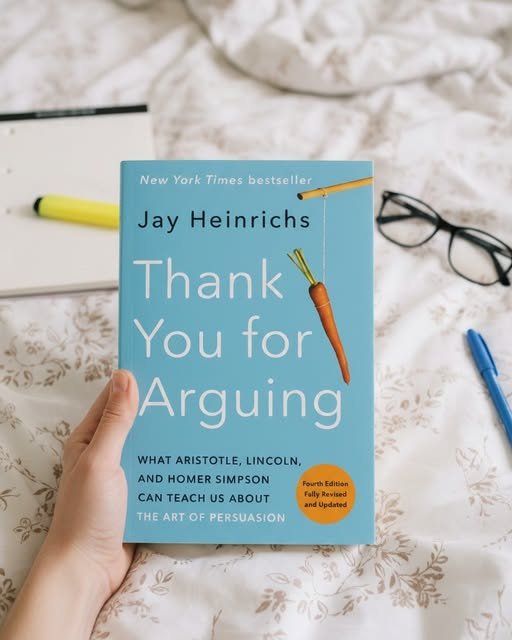

Thank You for Arguing by Jay Heinrichs is a practical, modern guide to persuasion built on classical rhetoric. Rather than treating arguments as verbal battles to be won with facts, the book reframes argument as a tool for influence, connection, and timing. Heinrichs argues that most people lose arguments not because they are wrong, but because they argue badly — focusing on logic when emotion, credibility, and context matter more.
The book blends ancient ideas from Aristotle with real-world examples from politics, parenting, relationships, advertising, and everyday conversations. It teaches readers how persuasion actually works in real life, not how we wish it worked.
The Core Idea of the Book
The central argument of Thank You for Arguing is simple but uncomfortable:
People don’t change their minds because of facts. They change their minds because of feelings, trust, and timing.
Once that is understood, argument becomes less about proving a point and more about guiding an outcome.
Ethos, Pathos, and Logos — The Foundation of Persuasion
Heinrichs builds the book around Aristotle’s three rhetorical appeals, showing how they function in modern arguments.
Ethos: Persuasion Through Credibility
Ethos is about how trustworthy, fair, and relatable you appear. According to Heinrichs, people listen to arguments based largely on who is making them.
If you sound arrogant, biased, or dismissive, your argument collapses before it begins. Strong ethos comes from:
-
showing respect for opposing views,
-
appearing reasonable rather than aggressive,
-
and aligning with shared values.
Pathos: Persuasion Through Emotion
Pathos is where most arguments are actually won.
Heinrichs explains that emotion is not the enemy of reason — it is the gateway to it. People make decisions emotionally and justify them logically afterward. Effective persuaders understand how to:
-
calm anger,
-
appeal to values,
-
create desire,
-
or reduce fear.
Ignoring emotion makes an argument ineffective, no matter how logical it is.
Logos: Persuasion Through Logic
Logic still matters, but Heinrichs positions it as support, not the lead act. Logic works best when it:
-
reinforces an emotional stance,
-
feels intuitive,
-
and is framed simply.
Complex logic often convinces no one.
Why Timing Matters More Than Being Right
One of the book’s strongest lessons is the concept of kairos, or the right moment to argue.
An argument can fail simply because:
-
the listener is defensive,
-
emotions are too high,
-
or the issue isn’t urgent yet.
Heinrichs emphasizes that persuasive people know when to speak and when to wait.
Argument as a Tool, Not a Weapon
Throughout the book, Heinrichs discourages confrontational arguing. He explains that aggressive debate:
-
creates resistance,
-
damages relationships,
-
and hardens opposing views.
Instead, persuasion works best when it feels cooperative. The goal is not to defeat your opponent, but to move them slightly in your direction.
How People Manipulate Arguments
The book also explores common argumentative tricks, including:
-
false dilemmas,
-
emotional baiting,
-
straw-man arguments,
-
and misleading comparisons.
By understanding these tactics, readers learn how to recognize weak arguments and respond calmly rather than emotionally.
Arguments in Relationships and Everyday Life
One of the most relatable sections of Thank You for Arguing focuses on arguments with people we care about — spouses, parents, friends, and coworkers.
Heinrichs explains that in close relationships:
-
logic often matters less than tone,
-
history matters more than facts,
-
and persuasion must protect the relationship itself.
Winning an argument at the cost of trust is still a loss.
The Role of Humor in Persuasion
Humor is presented as a powerful rhetorical tool. Used well, it:
-
lowers defenses,
-
signals confidence,
-
and reframes tension.
Heinrichs uses humor throughout the book to demonstrate that people are more open when they feel relaxed rather than attacked.
Final Takeaway
Thank You for Arguing teaches that argument is unavoidable — but it doesn’t have to be destructive. Persuasion is a skill grounded in empathy, timing, and credibility, not dominance or intellectual superiority.
The book ultimately argues that the best persuaders are not the loudest or the smartest, but the most aware of human behavior.