
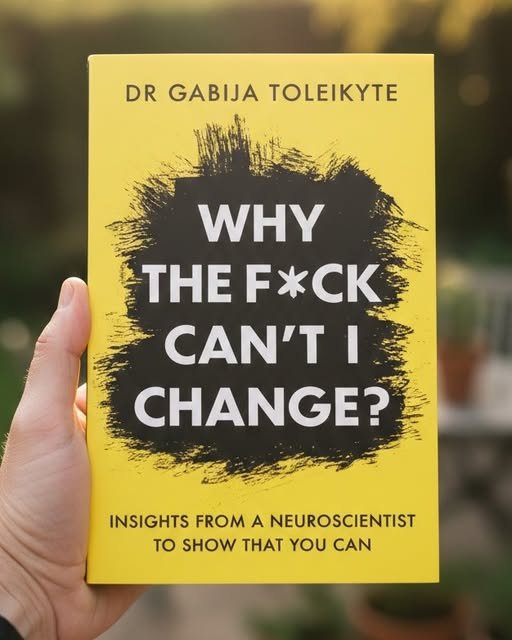

Most self-help books start with the assumption that you’re not trying hard enough.
Why the Fck Can’t I Change?* starts with a more compassionate—and far more accurate—question: what if your brain is doing exactly what it was designed to do?
Written by neuroscientist and behavioural coach Dr. Gabija Toleikyte, this book strips away shame, willpower myths, and motivational noise to explain why humans struggle with change—and what actually works instead.
This isn’t hype. It’s science made readable. Here are some key lessons from the book:
Change fails because the brain treats it as a threat, not a goal
One of the book’s most important teachings is that change automatically activates the brain’s threat system. Even positive change (exercising, leaving a bad habit, setting boundaries) introduces uncertainty, and uncertainty = danger to the brain.
The key lesson here:
-
When your brain senses uncertainty, it prioritizes safety over progress
-
Safety often looks like doing what you’ve always done
-
Resistance is not sabotage, it’s protection
This reframes self-sabotage as a biological response, not a character flaw. The practical implication is that lasting change must reduce perceived threat, not increase pressure.
Willpower is unreliable because it competes with emotional systems
The book makes a very clear distinction between rational intention and emotional decision-making.
You don’t fail because you lack discipline.
You fail because:
-
emotions operate faster than logic
-
emotional systems override plans when stress appears
-
willpower collapses when fear, fatigue, or discomfort shows up
A core teaching is that logic alone cannot defeat emotion. Sustainable change happens only when emotional needs are addressed alongside goals.
In other words:
If a habit serves an emotional function, removing it without replacing that function will fail.
Every habit exists because it solves a problem (even bad ones)
One of the most practical teachings in the book is that no habit is random.
Habits persist because they:
-
reduce discomfort
-
provide relief, control, or familiarity
-
help regulate emotions
The book teaches readers to stop asking “How do I stop this habit?” and instead ask:
-
What problem does this habit solve for me?
-
What emotion does it regulate?
Only when you understand the job the habit is doing can you replace it with something that works just as well, or better.
Motivation increases when effort feels meaningful, not when goals feel big
A non-obvious but powerful lesson is that motivation doesn’t grow from ambition, it grows from perceived meaning and achievable progress.
The book explains that motivation rises when:
-
the brain expects a reward
-
progress feels visible
-
effort feels aligned with personal values
Big goals often kill motivation because they:
-
increase uncertainty
-
raise the risk of failure
-
overwhelm the nervous system
The teaching here is precise:
Lower the psychological cost of starting, not just raise the importance of finishing.
Identity determines behaviour more than goals do
A deeper psychological layer of the book focuses on identity.
You don’t act against your goals — you act in alignment with who you believe you are.
Examples the book indirectly highlights:
-
If you see yourself as “not consistent,” consistency will feel unnatural
-
If you see yourself as “easygoing,” boundaries will feel threatening
-
If you see yourself as “bad with money,” saving will feel fake
The lesson:
Change sticks when it aligns with identity — or when identity is consciously updated.
This is why behaviour change without identity work often collapses.
Awareness alone does not create change — regulation does
The book is very clear that self-awareness is not enough.
Knowing why you behave a certain way does not automatically stop the behaviour.
Change requires:
-
emotional regulation
-
nervous system safety
-
tolerance for discomfort
This is why people can understand their patterns perfectly and still repeat them. The missing link is not insight, it’s capacity.
The teaching is subtle but crucial:
You must build the ability to sit with discomfort before behaviour can change.
Productivity problems are often emotional problems in disguise
Rather than treating procrastination or inconsistency as time-management issues, the book teaches that they are often emotional avoidance strategies.
People procrastinate to avoid:
-
fear of failure
-
fear of success
-
judgment (internal or external)
-
emotional exposure
The book reframes productivity as an emotional skill, not a scheduling one.
This shifts the solution from “do more” to “understand what you’re avoiding.”
Change happens through repetition, not transformation
One of the clearest teachings is that change is incremental neurological rewiring, not a personality overhaul.
The brain changes through:
-
repeated exposure
-
consistent replacement behaviours
-
reduced emotional threat over time
There is no moment where change suddenly feels natural — it becomes natural after repetition, not before.
This removes the illusion that you need to “feel ready” to begin.
Self-compassion is not softness, it’s a strategy
The book implicitly teaches that shame is one of the strongest blockers of change.
Shame:
-
activates threat responses
-
narrows thinking
-
increases avoidance
Self-compassion, on the other hand:
-
calms the nervous system
-
increases learning
-
supports persistence
This is not framed as kindness for kindness’ sake, but as neurologically efficient behaviour change.
The Real Takeaway of the Book
The core teaching of Why the Fck Can’t I Change?* is this:
You don’t change by fighting yourself.
You change by understanding how you work.
The book teaches readers to stop moralizing behaviour and start designing change around the brain’s actual operating system.
Who This Book Is For
This book is ideal for:
-
readers tired of shallow motivation
-
people who feel stuck despite “knowing better”
-
anyone curious about the science behind habits, emotions, and behaviour
-
readers who want depth without academic overload
It doesn’t shout. It explains. And that’s why it works.